

The Science Behind Your Daily Step Count for Health
Daily step count for health is one of the simplest, most powerful levers you can pull to protect your heart, your brain, your mood, and your longevity — and the science has a lot more nuance to offer than the familiar “10,000 steps a day” slogan suggests.
Here is what the current research says about how many daily steps are associated with meaningful health benefits:
The good news is that even a modest increase from where you are right now — say, from 3,000 steps to 4,000 — can produce real, measurable improvements in your health. You do not need to hit a perfect number to start making a difference. Every step genuinely counts.
For women navigating the physical changes that come with midlife, understanding your personal daily step count for health is especially meaningful. As your body changes, movement becomes one of the most protective things you can do — not just for your waistline, but for your bones, your cognitive function, your emotional resilience, and your energy levels. Whether you are in the Winona Lake and Warsaw area or connecting with us virtually, this guide will walk you through exactly what the evidence says, and how to apply it in a way that fits your real life.
I’m Joy Grout, owner of Personalized Fitness For You, and with over 20 years of experience working with women across clinical and community settings — including as a Certified Brain Health Trainer, Functional Aging Specialist, and Bone Health Instructor — understanding the practical role of daily step count for health has been central to the personalized programs I design for every client. Let’s explore what the research really tells us, and how to use it to help you move with more confidence, energy, and purpose.

Many of us grew up believing that 10,000 steps was a magic, scientifically-proven number required for fitness. However, the history of this goal is rooted more in clever marketing than in medical research. The figure originated in the 1960s with a Japanese company that released a pedometer called the “Manpo-kei,” which translates to “10,000-step meter.” They chose the number because the Japanese character for 10,000 resembles a person walking, and it sounded like a formidable, yet catchy, fitness goal.
While 10,000 steps is certainly a wonderful achievement, recent meta-analyses show that we can reap massive rewards at much lower levels. For many women in the Winona Lake and Warsaw area, striving for an arbitrary five-digit number can feel overwhelming, especially when balancing career, family, and the unique physiological shifts of midlife. The risk of premature death significantly decreases as step counts increase, but these benefits begin to level off long before the 10,000-step mark.
The real danger lies in remaining sedentary, which is generally defined as taking fewer than 5,000 steps per day. The average American adult currently takes between 3,000 and 4,000 steps, meaning most of us are just a short walk away from moving out of the “high-risk” category. At Personalized Fitness For You, we believe in a whole-istic approach that honors where your body is today. We focus on the spirit, mind, and body, ensuring that your movement plan supports your long-term vitality without causing undue stress or shame.
Before you push yourself to meet a generic goal, it is vital to understand how your unique health history—including bone density and joint health—impacts your needs. We invite you to schedule a Personalized Fitness Assessment to help us create a movement strategy tailored specifically to your body and goals.
Finding the Optimal Range for Midlife Wellness
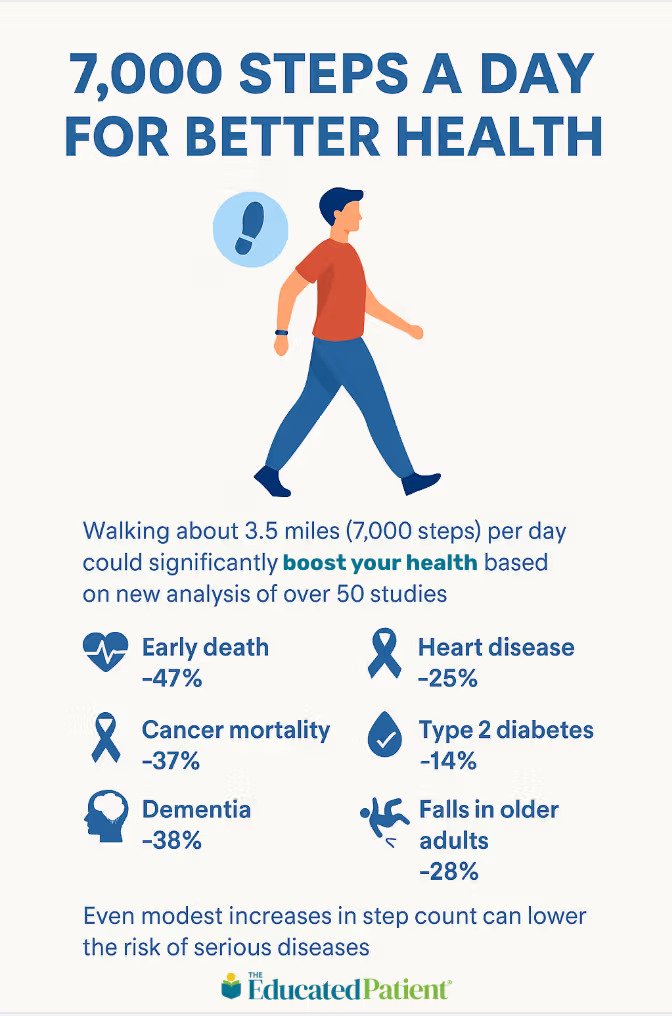
When we look at the most recent data on the daily step count for health, the findings are incredibly encouraging for those who find 10,000 steps out of reach. A comprehensive review and meta-analysis published in The Lancet Public Health suggests that 7,000 steps per day is a powerful milestone for longevity and disease prevention. This research highlights a “dose-response” relationship, meaning that as you take more steps, your health risks go down—but the most dramatic improvements happen in the jump from being inactive to moderately active.
For women in midlife, walking is about more than just cardiovascular health; it is a key component of dementia prevention and emotional well-being. The relationship between steps and health is often non-linear, which means you get a “bigger bang for your buck” in the first few thousand steps you add to your day. This is excellent news for anyone navigating busy schedules or joint discomfort, as it proves that you do not need to spend hours on your feet to protect your future. If you are looking for local support to help you implement these findings, you can learn more about our in-person training in Winona Lake where we specialize in functional movement for active aging.
Why 7,000 Steps is a Key Milestone for Your Daily Step Count for Health
Reaching 7,000 steps is often cited by experts as the point of “diminishing returns” for many health markers. This does not mean more steps are bad, but rather that 7,000 is the range where you have already captured the majority of the available health benefits. Compared to taking only 2,000 steps, hitting the 7,000-step mark is associated with a 47% lower risk of all-cause mortality. This is a life-changing statistic that is achievable for almost everyone with a bit of intentionality.
Beyond living longer, 7,000 steps per day is linked to a 25% lower risk of cardiovascular disease and a staggering 38% lower risk of dementia. As a Certified Brain Health Trainer, I emphasize to my clients that every step is a signal to your brain to stay sharp and resilient. Furthermore, this level of activity is associated with a 22% reduction in depressive symptoms, proving that movement is a vital tool for the “spirit and mind” as much as the body. For those who cannot make it to our local studio, our virtual training services provide the same expert guidance to help you reach these milestones from the comfort of home.
How Age Influences Your Daily Step Count for Health
As we move through different stages of life, our bodies’ requirements and capacities change. Research led by Amanda Paluch indicates that the “plateau” for health benefits happens at different levels depending on your age. For adults in their 60s and beyond, the risk of premature death appears to level off between 6,000 and 8,000 steps. Younger adults, who often have different biomechanical efficiencies and metabolic rates, may continue to see rising benefits up to the 8,000 to 10,000-step range.
This distinction is crucial because it allows us to set realistic, age-appropriate goals that prevent overtraining and injury. In our specialized bone health programs, we help women navigate these targets while focusing on the weight-bearing aspects of walking that protect against osteopenia and osteoporosis. We focus on quality of movement and functional mobility, ensuring that your daily step count for health supports a life of independence and strength.
Beyond Volume: Intensity and Whole-istic Movement
While the total number of steps is the most important factor for overall health, the intensity of those steps—often called cadence—can offer additional perks. Walking at a “brisk” pace, which is typically 3 to 3.5 miles per hour, helps to elevate your heart rate and improve aerobic capacity. You can use the “talk test” to gauge your intensity: if you can talk but not sing a song, you are likely walking at a brisk, moderate-intensity pace.
Adding variety to your walking routine can further activate different muscle groups. For instance, walking on an incline or taking a uphill-climb-health-incline-walking approach engages the glutes and core more deeply than walking on flat ground. This type of top-8-benefits-of-walking includes improved bone density and better balance, which are essential for navigating the physical changes of midlife. If you are recovering from a medical procedure, our post-rehab support can help you safely reintroduce these intensities without compromising your healing process.
Practical Ways to Navigate Your Walking Journey
Increasing your daily step count for health does not require a complete lifestyle overhaul. If you are currently at a sedentary baseline of 3,000 steps, your first goal should simply be to add 1,000 steps—about 10 to 12 minutes of walking—to your daily routine. Small, incremental changes are much more sustainable than trying to double your activity overnight. We often recommend “habit stacking,” such as taking a short walk after a meal, which also helps manage blood sugar and supports clean eating goals.
Consider these simple strategies to naturally increase your movement:
- Park your car further away from the entrance when running errands in Warsaw or Syracuse.
- Take the stairs instead of the elevator whenever it is a safe option for your joints.
- Pace around the house while talking on the phone or waiting for the microwave.
- Break your walking into three 10-minute bouts if a single 30-minute walk feels too long.
To help you visualize the difference, here is a comparison of how different activity levels impact your wellness:
| Activity Level | Daily Step Range | Impact on Active Aging |
|---|---|---|
| Sedentary | Under 5,000 | Higher risk of bone loss, cognitive decline, and heart issues |
| Low Active | 5,000 – 7,000 | Initial protection for heart health and mood stabilization |
| Active (Optimal) | 7,000 – 9,000 | Significant reduction in chronic disease risk and mortality |
| Highly Active | 10,000+ | Excellent for fitness maintenance; benefits plateau for longevity |
By focusing on these small wins, you nourish your spirit and body without the stress of perfection. Our customized wellness plans are designed to help you navigate these transitions with expert accountability and encouragement.
Frequently Asked Questions about Walking and Wellness
Is walking fewer than 5,000 steps considered sedentary?
Yes, most health organizations and researchers categorize taking fewer than 5,000 steps per day as a sedentary lifestyle. Being in this category is linked to higher risks of obesity, type 2 diabetes, and cardiovascular complications. However, it is important not to feel discouraged if you are currently below this number. The most significant health gains occur when you move from the sedentary category into the “low active” range (5,000 to 7,000 steps). Starting with just a few extra minutes of movement each day can begin to shift your health profile in a positive direction.
Does walking intensity matter as much as the total count?
The total volume of steps is the strongest predictor of health benefits like reduced mortality and disease risk. However, intensity—or how fast you walk—can provide extra cardiovascular and cognitive boosts. Brisk walking helps improve your “exercise capacity,” which is a fancy way of saying how well your heart and lungs can handle physical stress. At Personalized Fitness For You, we look at the whole-istic picture. While we want you to get your steps in, we also encourage incorporating moments of higher intensity or functional movements to ensure your body remains capable and strong as you age.
How can I safely increase my steps if I have joint pain?
Joint pain is a common concern for women in midlife, and it is important to navigate this carefully. First, ensure you have supportive, professional-grade footwear that is appropriate for your gait. Second, focus on surfaces that are easier on the joints, like a smooth trail or a well-maintained treadmill, rather than uneven concrete. We often suggest incorporating Pilates or general flexibility work to strengthen the muscles around your joints, which provides better stability and reduces pain during walking. If you are dealing with persistent discomfort, a consultation with a specialist can help you create a plan that respects your limitations while still allowing for progress.
Conclusion
Understanding your daily step count for health is a journey of self-care, not a race toward a marketing slogan. The evidence is clear: while 10,000 steps is a great goal for some, the most vital health benefits—protecting your heart, sharpening your brain, and extending your life—are well within reach at 7,000 to 8,000 steps. By focusing on consistent, mindful movement, you are investing in a future of vitality and independence.
At Personalized Fitness For You, Joy Grout and our entire “exercise family” are here to support you in every step of that journey. We understand the unique challenges women face as they navigate midlife, from bone health concerns to the need for stress management that actually works. Our approach is always whole-istic, focusing on the spirit, mind, and body in a supportive, shame-free environment.
Whether you prefer the community feel of our Winona Lake and Warsaw area studio or the convenience of our virtual health coaching, we are ready to help you create a plan that is as unique as you are. Don’t let another day pass feeling overwhelmed by generic fitness advice. Take the first step toward a stronger, healthier you today.
Ready to transform your health with a plan tailored just for you? Click here to schedule your Personalized Fitness Assessment and Consultation and join a community that celebrates your progress at every stage of life.