

How a Strength Training Guide Can Help Women Train Smarter, Not Harder
A strength training guide gives women a clear, safe way to build real, functional strength through progressive resistance work, without guesswork, wasted effort, or unnecessary strain on sore joints. A simple plan is to train two to three days per week, work all major muscle groups, complete two to three sets of eight to twelve repetitions, and gradually increase resistance or reps every one to two weeks while allowing at least 48 hours of recovery for the same muscle groups. Starting with bodyweight, resistance bands, or light free weights is often enough to create meaningful progress.
Strength is about far more than what you can lift. Established health organizations like the Mayo Clinic note that regular resistance training helps preserve lean muscle, support metabolic health, improve balance, and sharpen cognitive function as your body changes through midlife and active aging. That matters for women balancing full schedules, shifting energy, and the desire to stay strong for daily life. The good news is that you do not need long gym sessions to see results. Many women can make meaningful progress with just two to three sessions of 20 to 30 minutes each week.
Whether you are beginning your fitness journey in Winona Lake, Indiana, looking for guidance near Warsaw, Indiana, or seeking support from home, this guide offers a practical 12-week path that honors your spirit, mind, and body. Personalized Fitness For You offers live fitness training virtually. Enjoy training from home with your furry friends by your side! Contact us for training options, and we can meet you anywhere you live in the continental US!
Hi! As the owner of Personalized Fitness For You, I am ready to meet you at the studio in Winona Lake, Indiana, or meet you live virtually! This strength training guide reflects a whole-istic, individualized approach, meeting us where we are and building beyond.
The Essentials of a Whole-istic Strength Training Guide
A whole-istic strength training guide explains how resistance training helps your muscles work against force so you can build strength, support brain health, and move through daily life with more confidence. That force can come from your body weight, resistance bands, dumbbells, or machines, and the goal is to help you train safely and consistently in a way that supports your spirit, mind, and body.
As your body changes through the seasons of life, you naturally begin to lose lean muscle mass. Regular strength work helps you maintain that muscle so everyday tasks feel easier and your energy stays steadier. Muscle tissue is more metabolically active than fat tissue, so preserving it also supports healthy metabolism and keeps you functionally fit.
The brain benefits are just as meaningful. Research supported by organizations such as the NIH shows that strength training can help support memory, thinking skills, and overall cognitive function, especially when combined with aerobic activity. Stress management also plays a key role here, because lowering chronic stress supports healthier brain function and better recovery. For a deeper look at how these movements fit into a balanced routine, explore the benefits of compound fitness.
Strength training and cardiovascular exercise each serve an important purpose. Strength work builds functional force for lifting, carrying, and getting up and down with ease, while cardiovascular exercise supports heart health and stamina. Both matter, especially for all women experiencing the different seasons of life. Take the steps to begin your fitness journey! I am ready when you are! Personalized Fitness For You will meet you at our studio in Winona Lake, Indiana, or meet you virtually anywhere in the US!
For most healthy women, the Mayo Clinic recommends working all major muscle groups at least twice a week. That balanced approach helps you build strength for daily living while supporting long-term wellness.
Building Your Foundation: Equipment and Safety
A strong foundation starts with choosing simple tools, learning safe form, and using a pace your body can recover from. If you have been sedentary for a while, are managing a chronic condition, or have ongoing joint pain, it is wise to talk with your doctor before starting a new routine so your plan matches your current needs.
If you want support as you begin, you can Book a Personalized Fitness Assessment to discuss your goals, movement history, and health considerations. You can start in person at our studio in Warsaw, Indiana, or train virtually from anywhere throughout the continental United States.
Many women are relieved to learn that a strength training guide does not require a full gym setup. Bodyweight movements, resistance bands, free weights, and weight machines can all be effective. Bodyweight exercises help you learn control. Resistance bands are portable and gentle on the joints while still creating steady tension. Dumbbells and kettlebells support natural movement patterns, and machines can provide extra stability when you are learning. The Pilates Reformer is also a method to increase strength and mobility. Personalized Fitness For You will meet you where you are! The studio is located in Winona Lake, Indiana, or meet you virtually for your personalized fitness session.
Safety also means moving with control. Slow, steady repetitions help you build strength while reducing unnecessary strain on joints and connective tissues. For women navigating recovery or medical concerns, movement can still be a key part of healing when guided well. For example, cancer recovery programs often include strength work to reduce fatigue and improve quality of life when done with medical clearance and skilled support. You can also learn more about individualized approaches through custom fitness training.
Mastering Three Movement Patterns for Functional Longevity
The foundation of any effective strength training guide rests on three movement patterns that mirror the actions you perform every day: the Squat, the Hinge, and the Push/Pull. These patterns help you sit down and stand up with ease, pick up a grocery bag from the floor, or push open a heavy door with confidence. Making certain you include foundational movements in your workouts is key!
- The Squat: This is the ultimate functional move. It targets your quadriceps, hamstrings, and glutes. Proper squat mechanics involve keeping your chest up, sitting your hips back as if reaching for a chair, and keeping your knees tracked over your toes.
- The Hinge: Unlike the squat, the hinge focuses on pushing the hips back while keeping a minimal bend in the knee. This strengthens the posterior chain, which includes the muscles along the back of your body, such as your glutes and lower back.
- The Push and Pull: These movements balance the upper body. A push, like a modified push-up, works the chest and shoulders, while a pull, like a seated row, strengthens the back and improves posture.
Core stability is the thread that ties these movements together. A strong core acts as a natural corset, protecting your spine during every lift. To strengthen this area, explore 9 core exercises for women to build that essential foundation.

Refining Technique in Your Strength Training Guide
Mastery of these movements comes down to the details. Form is more important than the amount of weight you use. Here are the pillars of proper technique:
- Neutral Spine/The hinge: Avoid excessively arching or rounding your back. Think of your spine as a straight line from your tailbone to the top of your head. “Hinging” is an important position to use while strength training.
- Tripod Foot: For standing exercises, distribute your weight evenly across three points of your foot: the heel, the base of the big toe, and the base of the little toe. This provides a stable base for your entire body.
- Braced Breathing: Exhale during the hardest part of the movement, which is the exertion phase, and inhale as you return to the starting position. This helps maintain internal pressure and protects your core.
- Controlled Tempo: A helpful guideline is a “2-1-2” tempo, meaning two seconds to lower the weight, a one-second pause, and two seconds to lift.
By focusing on these fundamentals, you ensure that you are targeting the correct muscles and avoiding unnecessary strain on your joints. You can learn more about individualized coaching through personalized fitness programs, which are designed to help you master these nuances with expert feedback.
Structuring Your 12-Week Program for Success
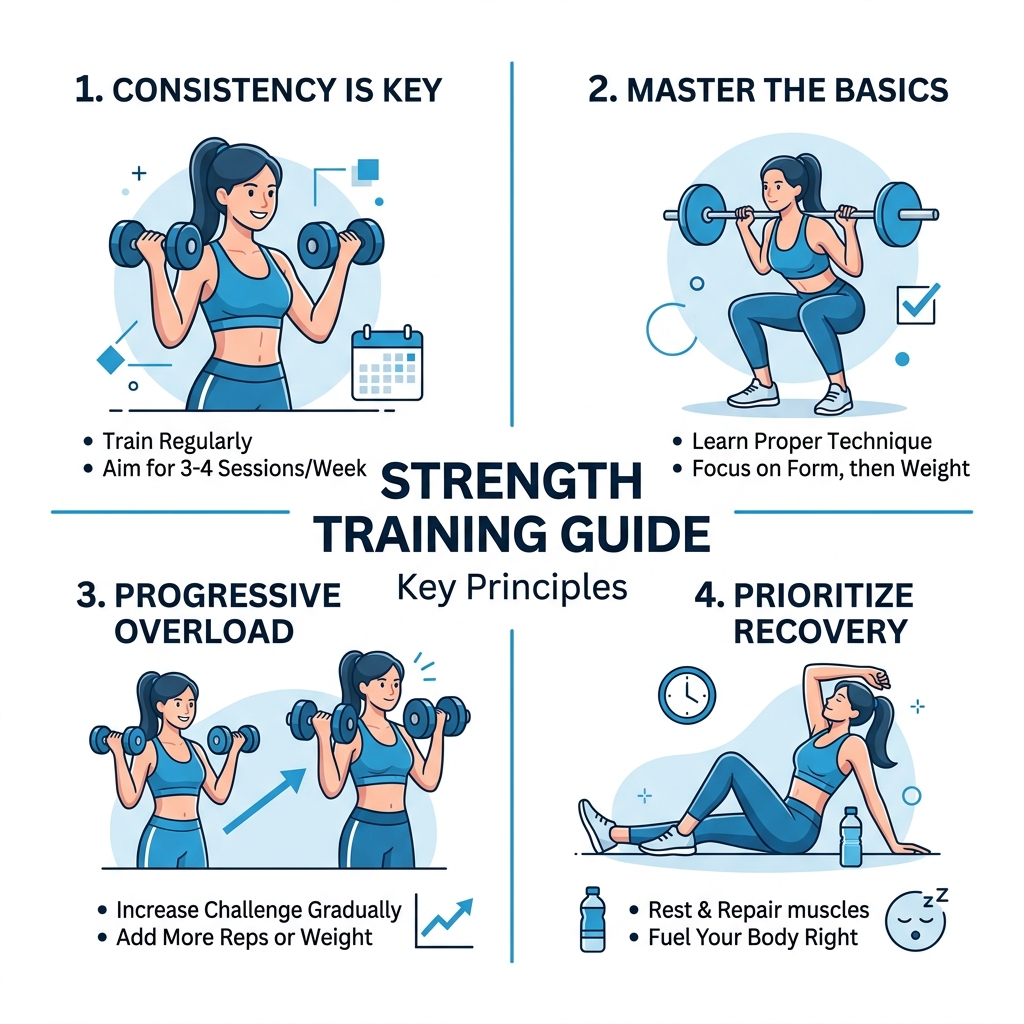
A successful strength training guide is built on the principle of progressive overload. This means that over time, you must gradually increase the stress placed on your body to continue seeing improvements. We break this down into three distinct phases over 12 weeks:
Phase 1: The Base Phase (Weeks 1-4)
The goal here is habit formation and movement proficiency. You will focus on learning the mechanics of these patterns using light weights or bodyweight. We typically aim for 2 sets of 12-15 repetitions. This higher rep range helps build muscular endurance and allows your nervous system to “learn” the movements.
Phase 2: The Strength Phase (Weeks 5-8)
Once your form is solid, we begin to increase the resistance. You might move from bodyweight squats to holding a light dumbbell. In this phase, we often drop the repetitions to 8-12 and increase to 3 sets. This is where you will start to feel a significant increase in your functional power.
Phase 3: The Peak Phase (Weeks 9-12)
In the final weeks, we focus on consolidating your gains. You will continue with 3 sets of 8-10 repetitions, ensuring the final two reps of every set feel challenging. This phase is about building the resilience and energy needed for a high quality of life. For more on maintaining vitality as we age, read about fitness program for active aging women.
Tracking Progress with Your Strength Training Guide
How do you know if you are working hard enough? We use the Rate of Perceived Exertion (RPE) scale, which ranges from 0 to 10.
- RPE 1-3: Very light activity (like a slow walk).
- RPE 4-6: Moderate effort (you can talk but your heart rate is up).
- RPE 7-8: Vigorous effort (the “sweet spot” for strength training; you can carry on a conversation, but it takes effort, and you would rather concentrate).
- RPE 9-10: Maximum effort (should be avoided by beginners to prevent injury).
“For most beginner sessions, aim for an effort level around 6 to 8 out of 10, where the last few repetitions feel challenging, but your form stays steady. We are all created uniquely, so listening to your body is important. You will know by listening to your body’s cues. Seeking guidance from a fitness trainer will help you develop the proper program for you. Personalized Fitness For You in Winona Lake, Indiana is ready when you are! We are ready to meet you at the studio or virtually!
Nutrition and Recovery for the Active Woman
Recovery is where your strength gains take shape, and the choices you make between workouts matter just as much as the exercises themselves. When you lift, your muscles experience small amounts of stress. During recovery, your body repairs that tissue and helps you come back stronger, steadier, and more energized. Rest should not be ignored! It is important for repair and rejuvenation.
A whole-istic approach to nutrition starts with clean eating and steady nourishment. Whole, minimally processed foods help support energy, recovery, and brain health. Protein is especially important because it provides the amino acids needed for muscle repair and supports healthy tissue as your body changes through midlife and active aging. Consistent protein intake across the day can make recovery more effective. You can learn more about protein for muscle repair here. Glycemic Index awareness also matters. Choosing carbohydrates such as berries, sweet potatoes, legumes, and whole grains can support stable energy for workouts and daily life without dramatic rises and drops in energy.
Stress management is another key part of recovery because chronic stress can interfere with muscle repair and have a negative impact on brain health. Supportive practices such as mindful breathing, walking, prayer, and quiet reflection can help calm the nervous system and support clearer thinking. Sleep matters too. Aim for seven to nine hours of quality sleep so your body and mind have time to restore.
On your off days, gentle movement can help you recover well. Pilates and general flexibility work can improve range of motion, ease stiffness, and help you feel more prepared for your next session. If you want more guidance connecting exercise, food, and recovery, one-on-one fitness coaching can provide the structure and accountability that make a real difference.
Frequently Asked Questions about Strength Training
How often should I perform strength training?
For most women in midlife, two to three days per week is the “goldilocks” zone. This frequency provides enough stimulus to trigger muscle growth while allowing for the 48 hours of rest required between sessions for the same muscle groups. Consistency is more important than intensity; it is better to do two 20-minute sessions every week than one two-hour session once a month.
Will lifting weights make me look bulky?
This is perhaps the most common concern we hear, and the answer is a resounding no. Women generally have a physiological makeup that makes it very difficult to build large, bulky muscles. Instead, strength training helps improve muscle tone, functional strength, and body composition over time. Most women find that they simply look more toned and feel much stronger in their daily lives. Feeling functionally strong makes a difference to our daily lives.
Can I start strength training at home?
Absolutely. You can perform squats, lunges, and push-ups in your living room. Check out our virtual training to get started. At Personalized Fitness For You, we can meet you at the studio or meet you virtually from the comforts of your home. We are located in Winona Lake, Indiana, and meet women virtually anywhere in the continental US.
Conclusion
A strength training guide can help you build the strength, mobility, and energy you need to move through midlife with greater functional movement and consistency. When you focus on the foundational movement patterns, practice steady progression, and support your body with recovery, you are investing in longevity, sharper thinking, and the freedom to stay active in daily life. This is not about chasing a number on the scale. It is about honoring your spirit, mind, and body with training that gives you a whole-istic approach
Taking stewardship to care for our bodies is important.
Personalized Fitness For You offers a supportive path for women who want expert guidance that feels encouraging, personal, and achievable. If you are ready to stop guessing and start building lasting strength, now is the time to take the next step. Personalized Fitness For You is ready to help when you are!
Ready for a personalized next step? Book your Personalized Fitness Assessment today! Start your journey in person at our studio in Warsaw, Indiana, or start your journey virtually from anywhere throughout the continental United States.


