


Understanding the Science of DOMS and Muscle Recovery
DOMS — short for Delayed Onset Muscle Soreness — is the deep, dull aching feeling that settles into your muscles roughly 24 to 72 hours after a workout that challenged your body in a new or more intense way. It is one of the most common experiences for anyone who exercises, from seasoned athletes to women just beginning their fitness journey at any season of life.
What is DOMS at a glance:
- What it is: Muscle soreness and stiffness caused by microscopic tears in muscle fibers during exercise
- When it starts: Typically 12 to 24 hours after exercise
- When it peaks: Between 24 and 72 hours post-workout
- How long it lasts: Usually resolves within 5 to 7 days
- Primary cause: Eccentric (lengthening) muscle contractions, such as the lowering phase of a bicep curl or walking downhill
- What it means: Your muscles are repairing and adapting — which is how they grow stronger
Often, women navigating ask the familiar question after a workout: “Is this soreness normal, or did I push too hard?” That question matters, and understanding what is actually happening inside your muscle fibers is the first step toward training smarter, recovering fully, and building genuine, lasting strength — not just in your body, but in your spirit and mind too.
In most cases, DOMS is a normal response to a new or more challenging workout, not a sign that something has gone wrong. It is, in many ways, evidence that your body is doing exactly what it is designed to do — breaking down, rebuilding, and coming back more capable than before. The key is knowing how to support that process wisely, especially as your body changes and recovery naturally requires more intentional care.
Hi, as the owner of Personalized Fitness For You, and with over 20 years of experience working with women in clinical and community-based fitness settings, I hear the question regarding muscle soreness and whether it’s a good thing or not! Educating individuals about DOMS helps every woman understand what their body is going through or what to expect. In this guide, I will walk you through exactly what your muscles are experiencing — and how to work with your body, not against it.
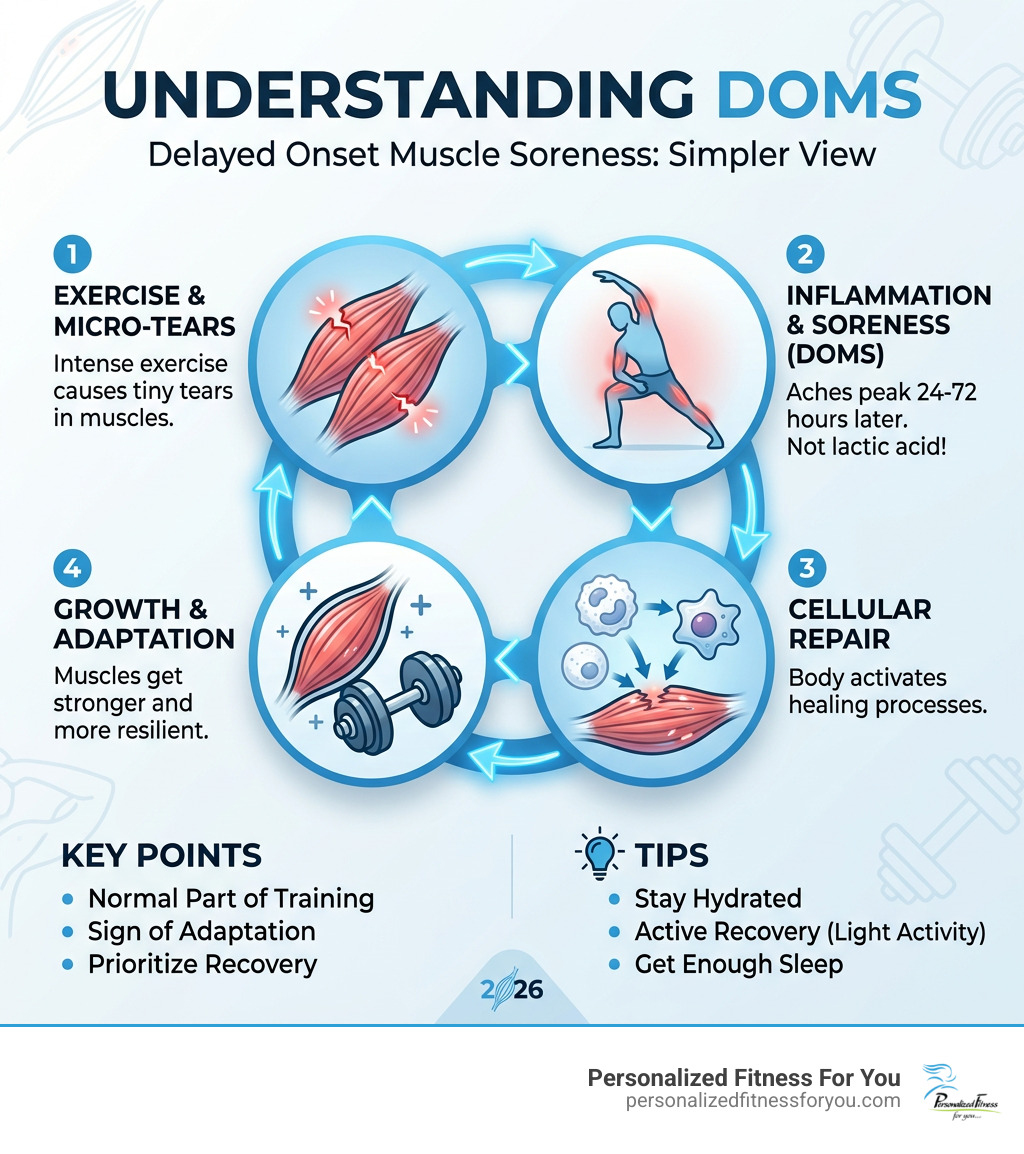
DOMS is the clinical term for the muscle pain, tenderness, and stiffness that develops after unaccustomed or strenuous physical activity. When we engage in a new exercise routine or increase the intensity of our movements, we place a load on our muscles that they aren’t quite used to yet. This results in microscopic damage to the myofibrils—the tiny filaments that make up our muscle fibers—specifically at a structure called the Z-line.
This exercise stress can trigger an inflammatory response that contributes to DOMS as your body repairs and adapts. While “inflammation” often sounds like a negative word, in this context, it is a vital part of the healing process. White blood cells rush to the area to clear out damaged debris, and fluid shifts occur, which can cause the slight swelling or “tight” feeling you notice a day or two after your session. This process is essentially your body’s way of reinforcing its structure.
Prioritizing wellness means understanding that this recovery phase is just as important as the workout itself. If you are looking for a more hands-on approach to your recovery and training, you can learn more about our in-person training options. Scientific research on muscle soreness mechanisms suggests that while several theories exist, the most likely cause is a combination of these factors working together to signal the need for repair.
Ready to discover a fitness plan that works with your unique needs? Book your complimentary Personalized Fitness Assessment today. Personalized Fitness for You is located in Winona Lake, Indiana. I look forward to meeting you in the studio or meeting you virtually, live anywhere in the continental US! I am ready when you are!
Why Your Muscles Feel Sore After a Great Workout
The soreness you feel is the result of microscopic lesions within the muscle tissue. When you exercise, the mechanical stress causes a disruption in the sarcomeres—the basic functional units of your muscles. Specifically, the Z-lines, which act as the “anchors” for muscle contraction, experience tiny ruptures. As these fibers mend, your body initiates protein synthesis to build the muscle back stronger and more resilient.
This repair process is what leads to functional gains, but it requires the right environment to succeed. This is where our whole-istic approach to “spirit, mind, and body” comes in. Supporting your physical repair with clean eating and proper nutrition ensures your body has the “building blocks” (like high-quality protein) it needs to knit those fibers back together.
Many people still blame lactic acid for next-day soreness, but lactate clears long before DOMS peaks, so it is not what causes the ache that shows up a day or two later. DOMS is much more closely tied to tiny disruptions in muscle fibers and the inflammation and repair work that follow as your body rebuilds stronger tissue.

The Role of Eccentric Contractions in DOMS
The most significant trigger for DOMS is eccentric muscle action. This occurs when a muscle is tensed or squeezed while it is simultaneously lengthening. Think of the lowering phase of a bicep curl, where you are slowly resisting gravity, or the “braking” action your thighs perform when walking down a hill or downstairs.
Research on eccentric exercise and muscle damage shows that these lengthening movements create more tension on the muscle fibers than concentric (shortening) or isometric (static) movements. Because fewer motor units are recruited to handle the same load during the eccentric phase, each individual fiber takes on more stress, leading to those productive micro-tears.
Muscle repair and its affects for women 50+
As we navigate midlife season and our bodies change, the way we recover from DOMS shifts as well. Hormonal changes can lead to a decrease in hormonal production and a slightly slower inflammatory response, meaning that soreness might linger a bit longer than it did in our younger years.
This makes active aging recovery strategies essential. We must focus on protein intake to support muscle and bone health, as detailed in our Osteopenia Strength Training Complete Guide. Keeping our bodies hydrated with water pre, during, and post workouts is truly important for muscle repair. By providing the body with adequate nutrients and allowing for slightly longer rest periods between intense sessions, we can ensure that we continue to build strength safely and effectively.
Navigating the Difference Between DOMS and Injury
It is vital to distinguish between the “good” soreness of DOMS and the “warning” pain of a genuine injury. DOMS typically presents as a dull, aching pain or a feeling of stiffness that is most noticeable when you move the affected muscle or touch it. It generally peaks between 24 and 72 hours and starts to improve shortly after.
In contrast, an acute injury—like a muscle strain or tear—usually happens suddenly during the exercise itself. The pain is often sharp, stabbing, or localized to a very specific spot. While DOMS improves with light movement, an injury often feels worse or stays the same regardless of activity. Using a balanced routine, such as these 9 core exercises for women, can help you build the foundational strength needed to prevent these acute issues.
| Symptom | DOMS (Normal Adaptation) | Acute Injury (Seek Advice) |
|---|---|---|
| Onset | Delayed (12–48 hours later) | Immediate (During exercise) |
| Pain Type | Dull ache, stiffness, “tight” feeling | Sharp, stabbing, or “popping” sensation |
| Duration | Improves after 3–5 days | Persistent or worsens over time |
| Movement | Feels better with gentle movement | Feels worse with any movement |
| Swelling | Slight, generalized tightness | Significant, localized, or bruising |
When to Seek Professional Guidance for DOMS
While DOMS is a benign condition, there are rare instances where muscle overexertion can become serious. If your pain is completely debilitating, if you notice heavy swelling in your limbs that doesn’t go down, or if your urine becomes very dark (resembling tea or cola), you should seek medical attention immediately. These can be signs of rhabdomyolysis, a condition where muscle breakdown products overwhelm the kidneys.
For those who want to ensure they are progressing safely from the comfort of home, our virtual training programs provide the professional oversight needed to navigate these challenges without overstepping your body’s limits.
Whole-istic Strategies to Manage Soreness and Support Your Body
Managing DOMS isn’t about “getting rid” of it—since it’s a natural part of growth—but rather about supporting your body so you can stay active. Active recovery is the gold standard. Instead of sitting on the couch, try low-impact movements like walking, swimming, or Pilates. These activities increase blood flow to the sore muscles, which helps deliver nutrients and flush out metabolic waste.
Other effective strategies include:
- Magnesium Baths: Soaking in warm water with Epsom salts can help relax tight muscles.
- Hydration: Keeping your tissues hydrated is essential for cellular repair.
- General Flexibility Work: Gentle stretching can help restore range of motion, though it won’t “prevent” the soreness from occurring in the first place.
- Using a foam roller is an excellent option pre and post with any workout.
Nutrition and Brain Health in Recovery
What you put on your plate is just as important as what you do in the studio. Focusing on anti-inflammatory foods can help manage the discomfort of DOMS. Good nutrition, lower stress, and better sleep support full-body recovery and make it easier to return to exercise feeling steady and clear-headed.
Foods rich in Omega-3 fatty acids (like salmon or walnuts) and antioxidants (like spinach and peppers) support the body’s natural healing rhythm. Furthermore, managing stress through mindfulness or spiritual practices can lower cortisol levels, which in turn supports better sleep—the ultimate time for muscle and brain health repair. When we reduce physical stress through proper nutrition, we are also protecting our cognitive health by lowering overall inflammation in the body.
The Repeated-Bout Effect: Building Long-Term Strength
One of the most encouraging aspects of exercise physiology is the “repeated-bout effect.” This phenomenon means that when you perform an activity that causes DOMS, your muscles and nervous system adapt so quickly that the next time you do that same workout, the soreness will be significantly reduced—or even non-existent.
Research on the repeated-bout effect shows that even a single session of exercise provides a protective effect that can last for several weeks. This is why consistency is the key to functional movement. By sticking with your personalized plan, you are teaching your body how to handle stress more efficiently. In our Winona Lake community, we celebrate this progress as a sign of your growing resilience in spirit, mind, and body.
Frequently Asked Questions about DOMS
Can I exercise while experiencing DOMS?
Yes, you can certainly exercise with DOMS, provided the soreness is mild and doesn’t cause you to change your form. In fact, light, low-impact activity (active recovery) often makes the muscles feel better temporarily by increasing circulation. However, if the pain is so severe that you cannot move with proper mechanics, it is better to focus on a different muscle group or take a rest day to prevent compensatory injuries. It is important to listen to your body and its cues when you are experiencing muscle soreness.
How long does muscle soreness typically last?
For most women, DOMS begins to fade after the third day and is completely gone within five to seven days. If you find that you are still experiencing significant pain after a week, it may be a sign of a minor muscle strain rather than typical soreness, and it might be time to consult with a specialist to adjust your routine.
Does stretching before a workout prevent soreness?
Surprisingly, scientific evidence shows that static stretching before a workout does not prevent DOMS. While a dynamic warm-up is essential to prepare your joints and increase your heart rate, the micro-tears that cause DOMS occur due to the load and intensity of the exercise itself, which stretching cannot “block.” The best way to prevent severe soreness is a gradual progression of intensity over time. Try using a foam roller pre- and post-workout. Foam rolling acts as a form of self-myofascial release (SMR), using pressure to target deep fascia. Fascia is the dense connective tissue surrounding muscles. Foam rolling helps break up adhesions, increase blood flow, and improve flexibility
Conclusion
Understanding DOMS allows us to shift our perspective from seeing pain as a deterrent to seeing it as a sign of transformation. As your body repairs those tiny muscle fibers, it is building a stronger foundation for your future self—one with more energy, better balance, and mobility.
At Personalized Fitness For You, our mission is to help you navigate these physical changes one step at a time! Whether we are working on bone health, post-rehabilitation, or general functional strength, we focus on a whole-istic approach that honors your unique journey.
Serving the Winona Lake and Warsaw, Indiana area, we are here to ensure that every step you take is a safe and empowered one. Contact Joy today to build a personalized plan that supports DOMS recovery, strength, and long-term wellness. If you are a distance from the studio, consider the virtual training option. We will meet you anywhere, live virtually in the continental US!