

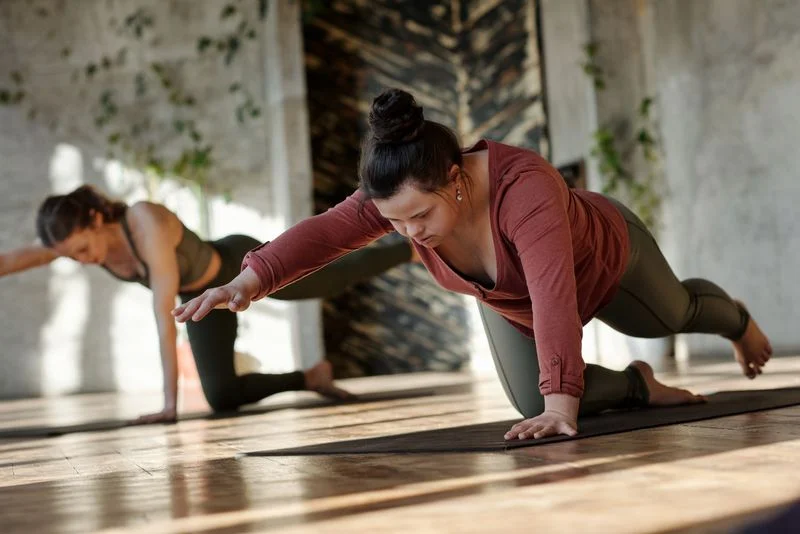
What Is Functional Fitness and Why Does It Matter?
What is functional fitness? Functional fitness is training that builds strength, balance, mobility, coordination, and stability for movements you use in everyday life. Instead of working one muscle at a time, functional fitness uses several muscles and joints together while building balance, mobility, coordination, and core stability.
Functional fitness can make exercise feel more connected to real life. As your body changes through different stages of life, functional movement supports the strength, energy, mobility, and confidence to stay active for the people and activities that matter to you. It also supports a whole-istic view of wellness that considers your spirit, mind, and body—not just what happens during a workout.
Functional training is also used in rehabilitation and fitness settings because it emphasizes movement with a practical purpose. Today, it can support active aging, busy schedules, joint-aware exercise, and long-term independence. The American College of Sports Medicine recognizes the value of training skills such as balance, coordination, and mobility alongside strength, while the National Institute on Aging emphasizes regular physical activity as an important part of healthy aging.
I am Joy Grout, founder of Personalized Fitness For You, with more than 20 years of experience in clinical and community-based fitness settings, including training as a Functional Movement Specialist and Functional Aging Specialist Instructor. In this guide to what is functional fitness, I will help you navigate practical movement that supports strength, mobility, cognitive health, and well-being at every life stage.
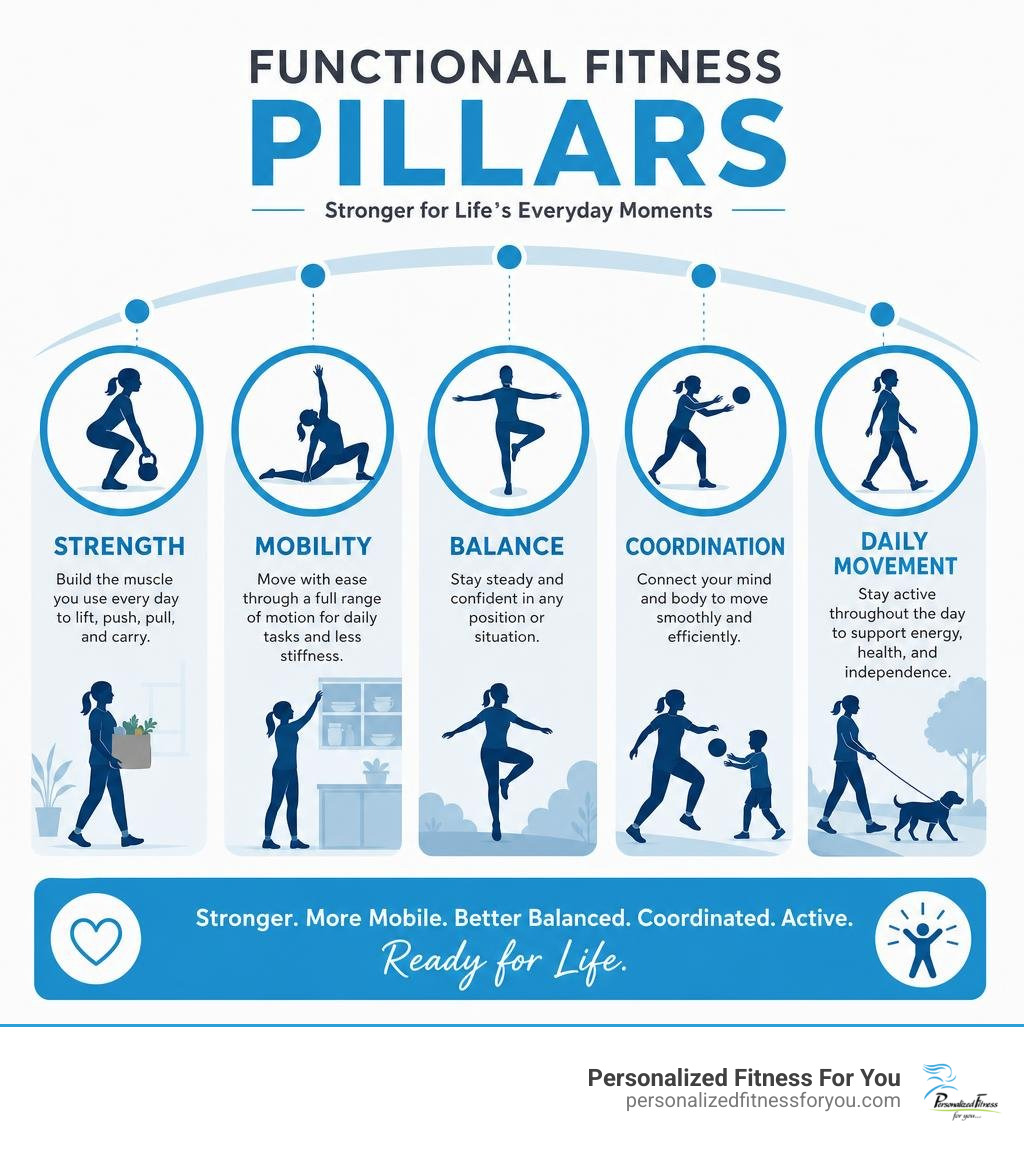
Understanding What Is Functional Fitness and How It Works
To understand what is functional fitness, it helps to look at how your body moves through daily activities. Every time you reach overhead for a dish, squat down to pick up a laundry basket, or pivot quickly to answer the door, your brain and muscles work together in a synchronized sequence. Functional fitness trains this entire system as a connected whole.
At the center of functional training is the concept of the kinetic chain. As described by Harvard Health Publishing, your body is supported by an interconnected network of bones, muscles, tendons, and joints. When one joint moves, it creates a ripple effect across the entire system. Training integrated movement patterns can help improve coordination, stability, and movement control across multiple joints and muscle groups.
Functional workouts often combine multi-joint movements with mobility and movement in multiple directions, reflecting many of the ways your body moves outside the gym. This mirrors the demands of real-world tasks, such as carrying heavy items into your home in Winona Lake, Indiana, or tending a garden in Warsaw, Indiana. By learning how everyday movement impacts energy burn and vitality through our guide on Functional Movement Explained: Harnessing NEAT to Transform Your Daily Health, you can see how daily activity forms a foundation for long-term health.
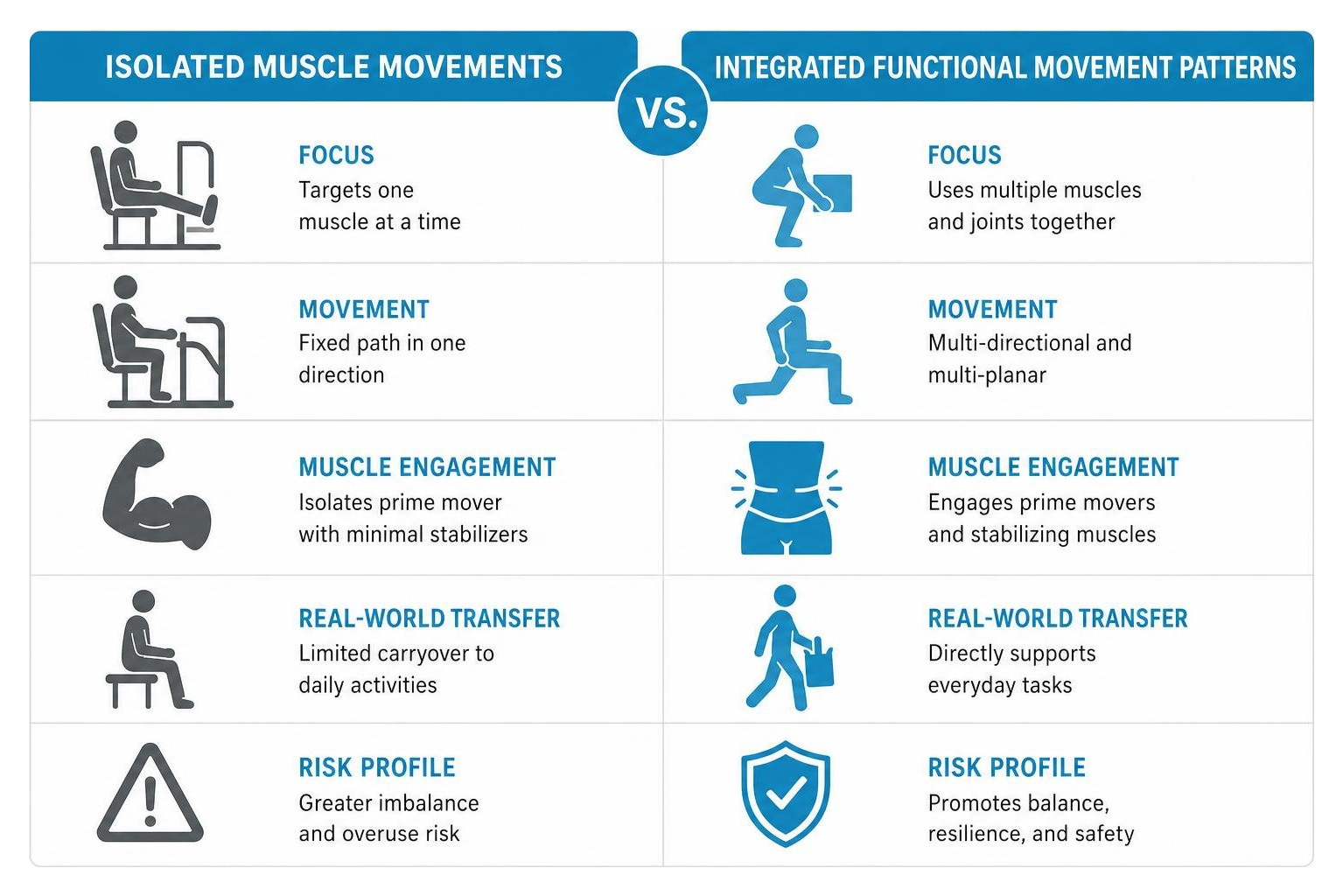
Key Differences: What Is Functional Fitness Compared to Machine Isolation?
Traditional strength training often relies on gym machines designed to isolate single muscle groups. While machine isolation exercises can help target isolated muscles, they do not always match the ways your body moves outside the gym. Understanding functional fitness helps clarify the difference between isolated muscle training and integrated movement training.
Functional exercises emphasize muscle synergy, core stability, and multi-planar movement. In real life, you rarely move in only one flat plane. You turn, bend diagonally, and step sideways. Functional training prepares your body for these real movements by engaging stabilizing muscles around your spine and pelvis during every exercise.
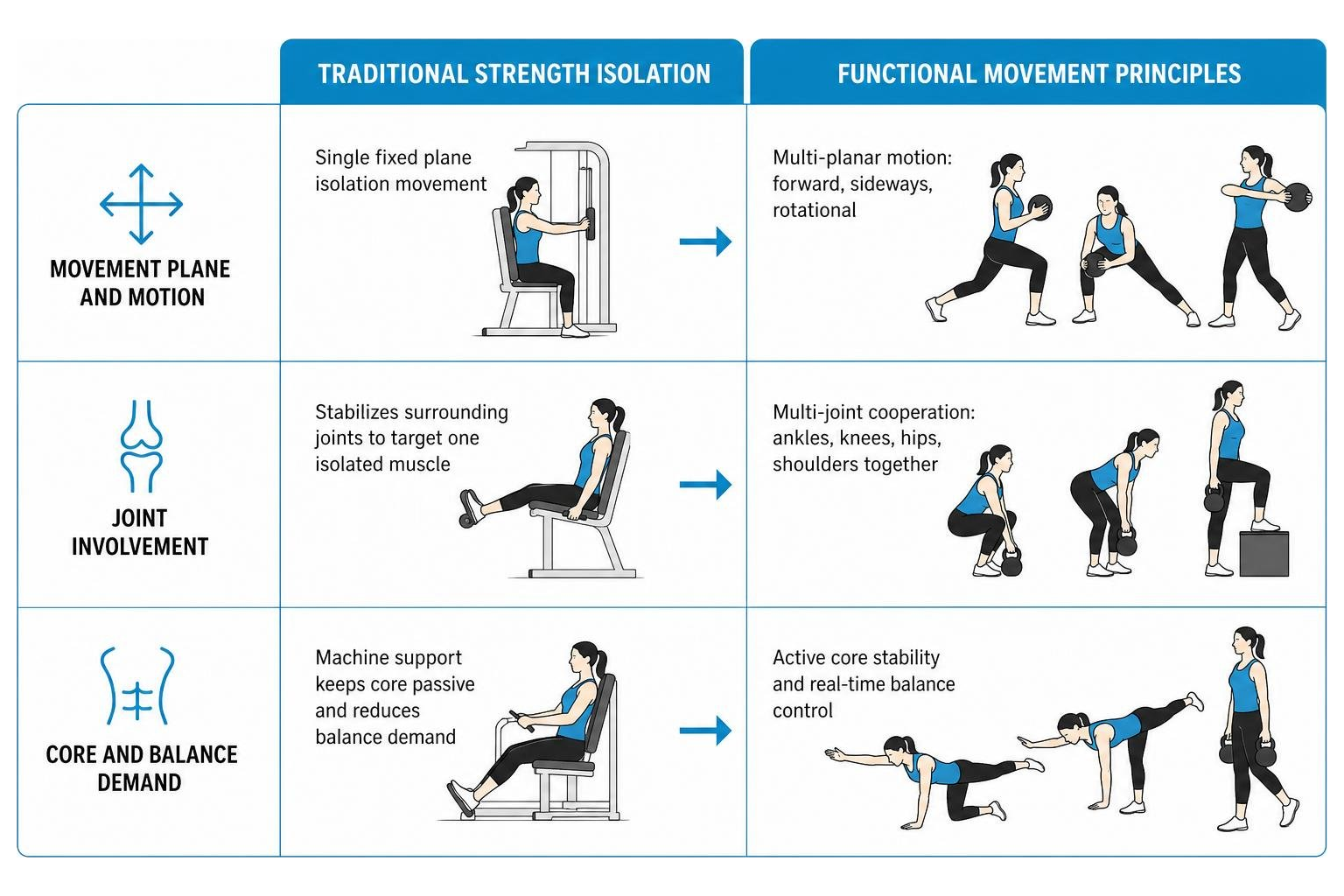
The following overview outlines how traditional machine isolation differs from integrated functional training across key physical factors:
- Movement plane and motion: Traditional machine training restricts your movement to a single fixed plane, whereas functional training encourages natural multi-planar motion across forward, sideways, and rotational directions.
- Joint involvement: Machine-based exercises often provide more external stability and may place greater emphasis on a specific muscle group.
- Core and balance demand: Some machines provide external support that reduces the balance and stabilization demands required during the exercise.
- Real-world movement transfer: Isolation exercises emphasize specific muscles, while functional movements typically coordinate several muscles and joints around a task or movement pattern.
Long-Term Health Benefits for Daily Life and Vitality

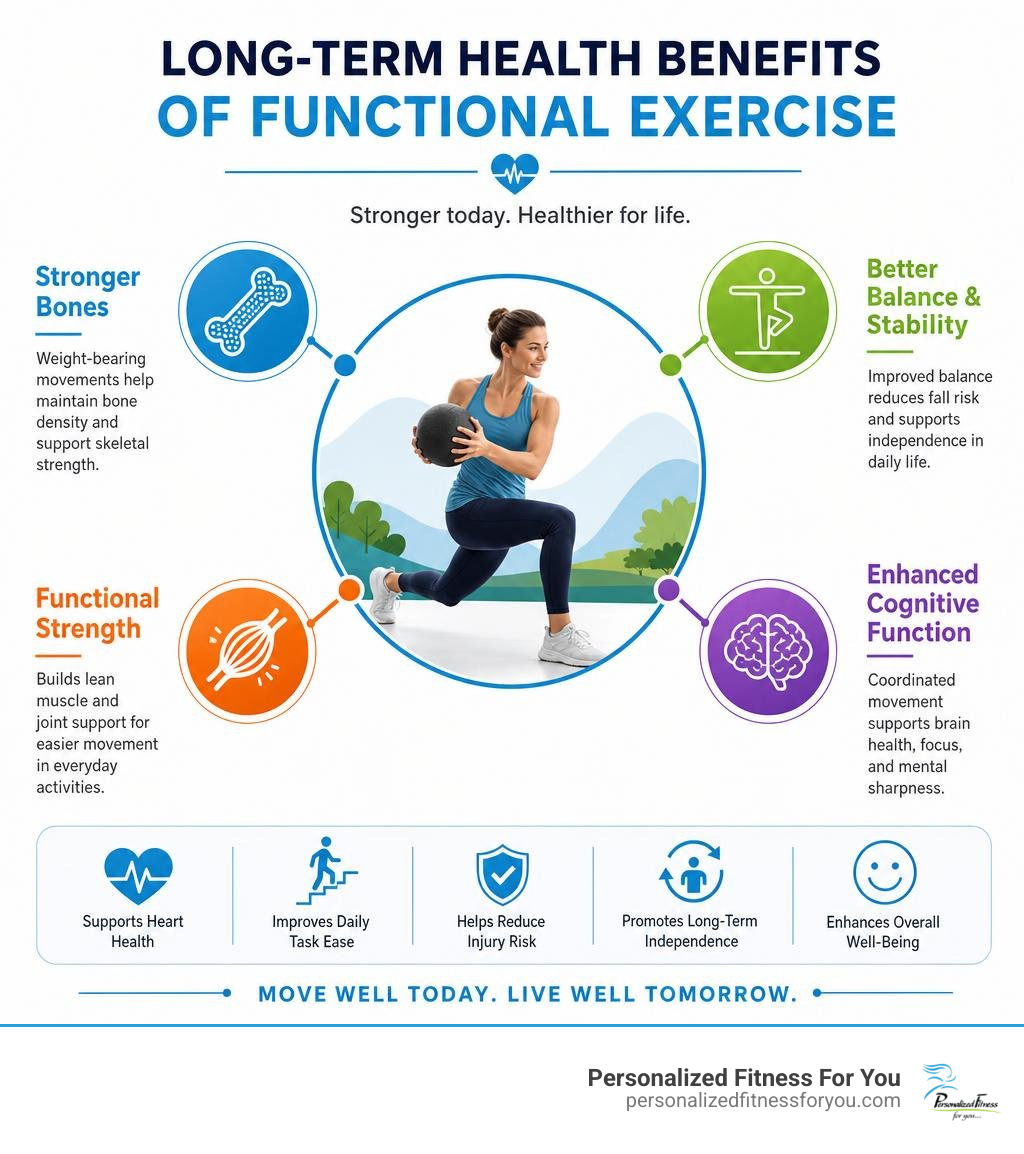
Understanding “what is functional fitness” means looking beyond immediate exercise performance to discover long-term vitality. Muscle mass naturally begins to decline gradually over time if it is not supported by intentional resistance training. When combined with appropriate resistance and progression, functional movements can support muscular strength, balance, mobility, and everyday physical function.
Functional training can improve strength and stability for everyday tasks, particularly when exercises are matched to your ability and performed with appropriate technique. Balance, strength, and multicomponent physical activity are important parts of maintaining physical function as we age.
Depending on the exercises, pace, and intensity, a functional workout may also challenge cardiovascular endurance while building strength. You can read more about cardiovascular physical adaptations in our article on 10 Surprising Benefits of Exercise for the Heart. Multi-joint exercises also require coordination, body awareness, and attention as you move through several steps or positions.
Core Movement Patterns: What Is Functional Fitness in Practice?
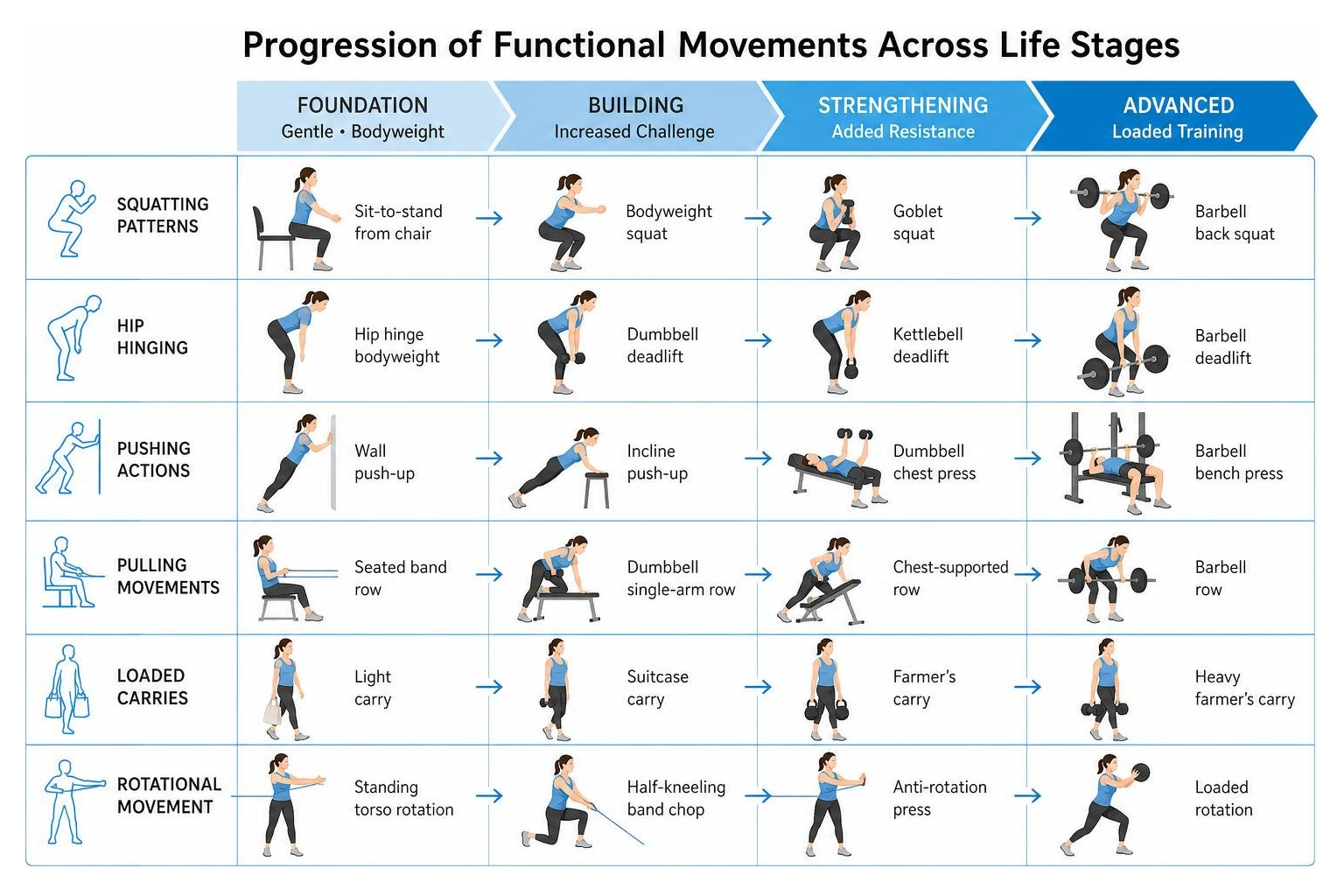
To build a well-rounded functional routine, we focus on fundamental movement patterns that reflect everyday physical activities. When learning what is functional fitness in practice, these foundational movements form the basis of a safe routine:
- Squatting patterns: The squat mimics sitting down and standing up from low chairs, cars, or couches. Practicing sit-to-stand transitions strengthens your quadriceps, glutes, and hips while training proper knee alignment.
- Hip hinging: The hip hinge teaches you to bend at your hips while keeping a neutral spine, which is essential for safely picking up objects from the floor without straining your lower back.
- Pushing actions: Pushing movements, such as wall push-ups or standing band chest presses, strengthen your chest, shoulders, and triceps for opening heavy doors or pushing open gates.
- Pulling movements: Pulling exercises, such as seated band rows or dumbbell single-arm rows, strengthen your upper back and rear shoulders, helping support good posture during long hours at a desk.
- Loaded carries: The farmer’s walk involves holding weights at your sides while maintaining upright posture and stepping forward with stability. This builds grip strength, shoulder alignment, and abdominal wall control for carrying heavy bags.
- Rotational movement: Torso rotations and anti-rotation holds train your core to manage turning forces, supporting actions like reaching across your body into a car trunk or looking over your shoulder.
Who Can Benefit from Functional Movement Across Life Stages?
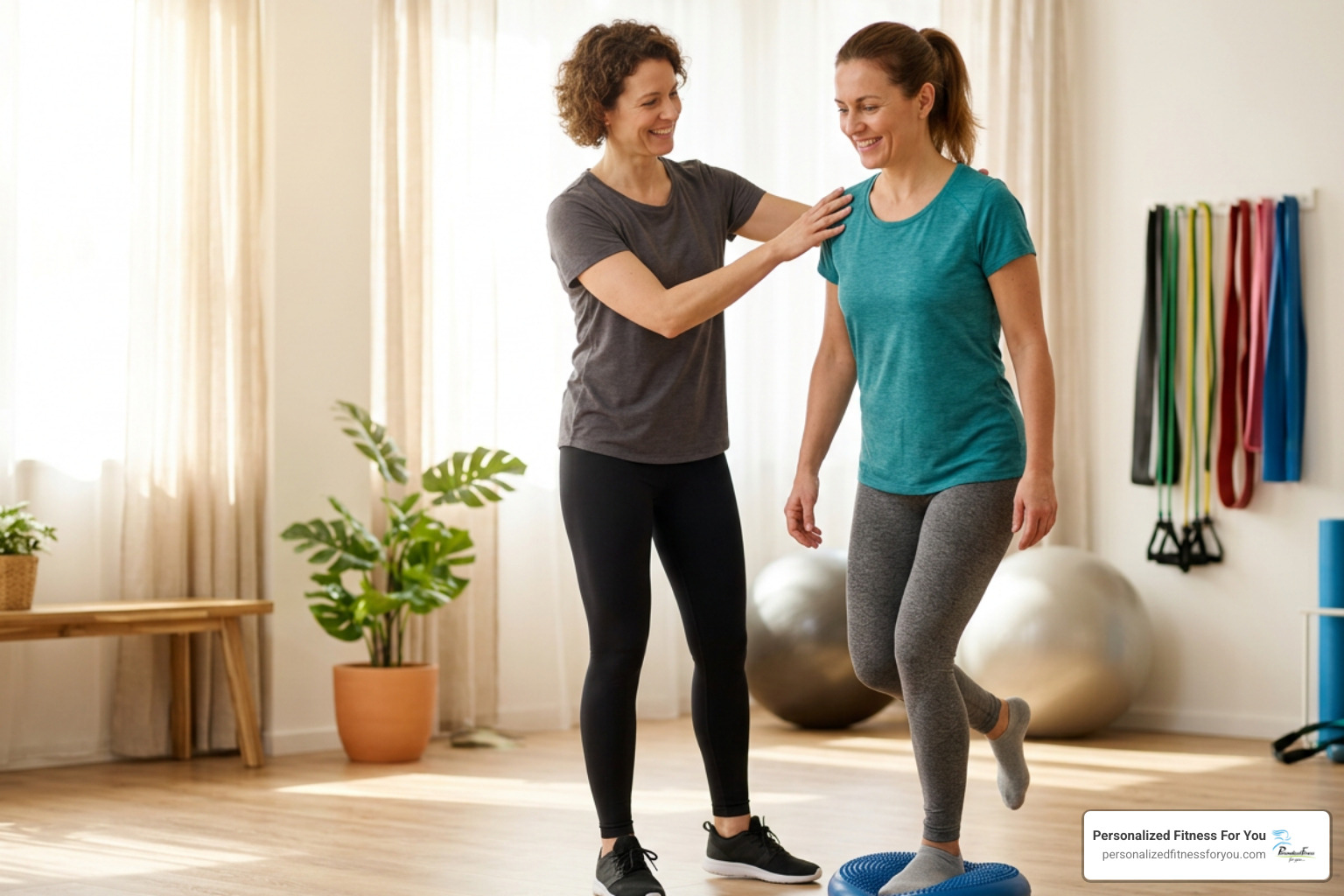
A common question people ask is what is functional fitness designed for and who can safely participate? Functional movement can be adapted for many ages, fitness levels, and physical abilities. Because functional exercises can be modified to match a person’s current capabilities, goals, and movement needs, this type of training can work for a wide range of people. It may be especially helpful for those managing busy schedules, rebuilding strength, improving balance, addressing mobility limitations, or simply wanting to move more confidently in everyday life.
As your body changes across different seasons of life, rigid exercise approaches can sometimes lead to joint discomfort. Functional movement can use adjustable resistance and individualized ranges of motion to help build strength while respecting joint comfort and current ability. Whether you are returning to exercise, maintaining independence, improving athletic capability, or simply wanting everyday activities to feel easier, functional exercises can be adapted to your starting point and goals.
For individuals working through joint stiffness or balance concerns, stability training offers a gentle entry point. You can learn how to protect your core and back in our Improve Core Stability Guide.
At Personalized Fitness For You, we recognize that functional fitness should not look the same for everyone. Individual health history, movement patterns, abilities, lifestyle demands, and personal goals all influence how an effective fitness program should be designed.
How to Get Started Safely with a Functional Routine
Getting started with functional fitness does not require overwhelming gym equipment or intense routines. Understanding what is functional fitness begins with mastering proper posture control, controlled breath, and balanced alignment using simple tools.
When beginning a functional exercise routine at home or in the studio, focus on these safety principles:
- Start with bodyweight progression: Master basic movements using your body weight alone before adding external resistance. Focus on smooth control rather than rapid repetitions.
- Incorporate accessible equipment: Simple tools such as light resistance bands, small kettlebells, stability balls, or household items like water bottles can add gentle resistance to your routines.
- Prioritize posture and spinal alignment: Maintain a neutral spine and engage your core during every movement to protect your lower back and promote healthy posture.
- Move at a controlled pace: Perform each exercise slowly to build neuromuscular control and joint awareness, avoiding sudden jerks or bouncing.
- Honor your body’s signals: Rest when you feel fatigued, and stop or modify an exercise if you experience sharp joint pain.
For foundational guidance on integrating strength training safely into your lifestyle, explore our article on Weight Training 101: Finding Your Basic Strength Training Program. You can also learn how custom planning supports overall health in our Ultimate Personalized Fitness Guide.
For hands-on instruction in a welcoming environment, discover our In-Studio Personal Training Services, where training with Joy at the studio in Winona Lake, Indiana provides personalized guidance tailored to your physical goals.
Frequently Asked Questions About Functional Fitness
How often should beginners do functional workouts each week?
Many beginners can start with strength-focused functional exercise on two or more days each week, with recovery and progression adjusted to individual needs. This schedule allows appropriate rest and recovery time for your muscles, joints, and nervous system to adapt. Resting between training days helps repair tissue, reduce soreness, and support long-term consistency. As your body adapts and moves with greater ease, you can gradually increase workout duration or introduce lighter mobility sessions on alternate days.
Can functional training protect joint health as your body changes?
Functional fitness can support strength, stability, balance, and movement quality as your body changes over time. Strengthening the muscles that support your hips, knees, ankles, and shoulders can improve stability and movement control around those joints. Weight-bearing functional moves also encourage synovial fluid circulation, which lubricates your joints and promotes smooth movement. When performed with proper alignment, functional workouts help reduce daily stiffness, restore active mobility, and protect joints from strain. If higher-impact activity is appropriate for you, progression should be gradual and based on your strength, movement quality, health history, and professional guidance when needed.
Do you need specialized equipment for functional exercise?
You do not need specialized equipment to begin functional fitness. Because functional training focuses on real-world movement patterns, bodyweight exercises such as sit-to-stand transitions, wall push-ups, and step-ups can be effective starting points. As you advance, you can easily incorporate simple home items such as filled water containers or basic equipment like light loop resistance bands, kettlebells, and exercise mats. The focus stays on movement control and whole-body coordination rather than heavy gym machinery.
Conclusion
Functional fitness provides a practical approach to building strength, mobility, balance, coordination, and movement confidence for everyday life. By training integrated movement patterns rather than focusing only on isolated muscles, functional exercise can help support the physical capabilities you use when standing, lifting, carrying, reaching, walking, climbing stairs, and participating in the activities that matter to you.
At Personalized Fitness For You, we believe effective fitness begins with understanding the individual rather than forcing everyone into the same program. Through personalized, compassionate, and shame-free guidance, the goal is to help you develop strength, mobility, and confidence that support your real life. Whether you are beginning again, maintaining your independence, improving how you move, or working toward new physical goals, your fitness plan should reflect your unique needs and starting point.
Ready to discover how functional fitness can support your strength, mobility, balance, and everyday movement? Contact Personalized Fitness For You to explore a personalized approach built around your body, abilities, and goals.